On Acyclic Models
We “discover” a generalization to the Fundamental Theorem of Homological Algebra (or Comparison Theorem) that is used in many a proof in algebraic topology; the Acyclic Models Theorem.
Many challenges in algebraic topology can, via naturality, be reduced to the problem of showing spaces or certain classes of spaces have trivial homology. For example, such is the case for showing homotopy invarianc of singular homology, since the functor $H_*(-; R)$ factors as
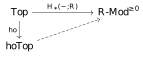
Generally speaking, the Acyclic Models Theorem is a powerful tool for showing that two functors $F$ and $G$ are naturally isomorphic, by showing that they are naturally isomorphic on a class of “acyclic models” (i.e. spaces with trivial homology). Before the statement of the theorem, we must clarify what exactly we mean by free and acyclic functors.
Definition 1. Let $\mathcal{C}$ be a category and $\mathcal{M} \subset \text{ob}(\mathcal{C})$ a class of objects. Then a functor $F:\mathcal{C} \to R\text{-Mod}_\text{dg}^{\geq 0}$ is defined to be
- free on $\mathcal{M}$ if there are objects $M_\alpha \in \mathcal{M}$ and elements $m_\alpha \in F(M_\alpha)$ such that for any $X \in \text{ob}(\mathcal{C})$, we have $$F(X) = R\left\langle \{F(f)(m_\alpha) \mid f \colon M_\alpha \to X\} \right\rangle$$
- acyclic on $\mathcal{M}$ if $H_*(F(M)) = 0$ for all $n>0$ and $M \in \mathcal{M}$.
The statement of being free on $\mathcal{M}$ need not be complicated; we’re just saying that the image of $F$ (a chain complex) gets generated by $F$ acting on morphisms from our models, which are our “well-behaved” objects. Acyclicity is as straightforward as its made out to be. Before stating the Acyclic Models Theorem, I want to recall the Fundamental Theorem of Homological Algebra so that the generalization, or “discovery,” is more clear. Plus it’s just an all-around goated result.
Theorem 1. Let $N$ and $M$ be $R$-modules whereis a free $R$-module resolution of $N$, where
is an exact sequence of $R$-modules, and where $f\colon N \to M$ is a homomorphism (category of $R$-modules). Then $f$ lifts to a chain map $f_*\colon F_* \to E_*$ which is unique up to chain homotopy.
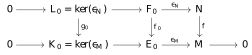 This lifting occurs via precomposition by the differential of the free resolution. Uniqueness up to chain homotopy is a consequence any two lifts differing by a chain map means that it is null-homotopic, which can be shown using the exactness of the sequence and the freeness of the resolution.
The most immediate and important consequence of this result is that of $\operatorname{Tor}$s functoriality and independence of free/projective resolutions (chain homotopy equivalence of resolutions). Consider a cool little result:
Claim 1. Letting $0 \to M' \to M \to M'' \to 0$ be a short exact sequence of $R$-modules, there exists a natural long exact sequence of the form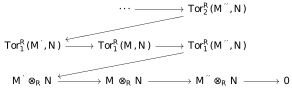
It’s not the worst thing in the world to show this; since tensoring is right-exact, we can form the short exact sequence
\[0 \longrightarrow F_* \otimes M' \longrightarrow F_* \otimes M \longrightarrow F_* \otimes M'' \longrightarrow 0\]using any free $R$-module (e.g. $R\langle M \rangle$ after passing $M$ to the forgetful functor). We can also specifically choose $F_* \to N$ to be a free resolution of $N$. Passing to the LES on homology with natural homomorphisms $\partial\colon H_n(F_* \otimes M’’) \to H_{n-1}(F_* \otimes M’)$ and applying the definition of $\operatorname{Tor}$ yields the sequence above. The bottom sequence stems from exactness of $F_1 \to F_0 \to N$ and hence that $H_0(F_* \otimes M) \cong N \otimes M$.
Now to unveil the Acyclic Models Theorem and neat application of it. The statement is as follows:
Theorem 2. Suppose have two functors $F, G \colon \mathcal{C} \to R\text{-Mod}_\text{dg}^{\geq 0}$ where $F$ is free on some models $\mathcal{M}$ and $G$ is acyclic on $\mathcal{M}$. Then,
- Any natural transformation $$\eta\colon H_0(F) \Rightarrow H_0(G)$$ lifts to a natural transformation $\tilde{\eta}\colon F \Rightarrow G$, and
- Given two natural transformations $F \Rightarrow G$ inducing the same natural transformation $H_0(F) \Rightarrow H_0(G)$, there is a natural (w.r.t morphisms in $\mathcal{C}$) chain homotopy between them.
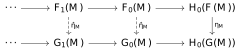 and extending to arbitrary $X \in \text{ob}(\mathcal{C})$ by naturality. Briefly, the first part (existence) is shown by constructing $\tilde{\eta}_0$ using the freeness of $F$ and the natural transformation $\eta$, and then lifting to $\tilde{\eta}_1$ using the acyclicity of $G$ on the models. The second part (uniqueness up to chain homotopy) is shown by observing that any two lifts differ by a chain map which is null-homotopic, which can be seen using the acyclicity of $G$ on the models. I may append this with a full proof in the near future, but its late right now. It's a fun one!
Take notice of the similarity between being free on $\mathcal{M}$ and the free sequence in FTHA, and the similarity between being acyclic on $\mathcal{M}$ and the exact sequence in FTHA. Now for a neat little example to bring this categorical nonsense back to earth.
Example 1. Let $\mathcal{C} = \text{Top}^2$ and our models be pairs of simplicies $$\mathcal{M} = \left\{ (\Delta^p, \Delta^q) \in \text{Top}^2 \mid p, q \geq 0 \right\}.$$ Suppose that our functors are specifically $$F = S_*(- \times -) \quad \text{and} \quad G = S_*(-) \otimes S_*(-)$$ which are both free and acyclic on $\mathcal{M}$! Where is free-ness coming from? Objects $\{(\Delta^n, \Delta^n)\}_n \in \mathcal{M}$ with $m_n \in S_n(\Delta^n \times \Delta^n)$ yield precisely $$S_n(X \times Y) = \mathbb{Z} \langle \{ S_*(\sigma_1 \times \sigma_2)(m_n) \mid \sigma_1 \times \sigma_2 \colon \Delta^n \times \Delta^n \to X \times Y \} \rangle.$$ For $G$, it's free with $\{\Delta^p \times \Delta^q \}$ since $$S_p(X) \otimes S_q(Y) = \mathbb{Z} \langle \{ S_*(\sigma_1)(\iota_p) \otimes S_*(\sigma_2)(\iota_q) \mid \sigma_1 \times \sigma_2 \colon \Delta^p \times \Delta^q \to X \otimes Y\} \rangle$$ where $\iota_p \times \iota_q$ is the generator of $S_p(\Delta^p) \otimes S_q(\Delta^q)$. It is upon thine to unearth acyclicity here.
I hope this quick exposition on the result of Acyclic Models was enlightening, at least to some degree, while also being a reminder that category theory is not entirely useless. If you’re seeing this revision of the post, my intention is to come back in a week or two and add some more details in for the proofs. Contingent on my business. Until next time.